NEWS
Read our latest publication in Antioxydants!
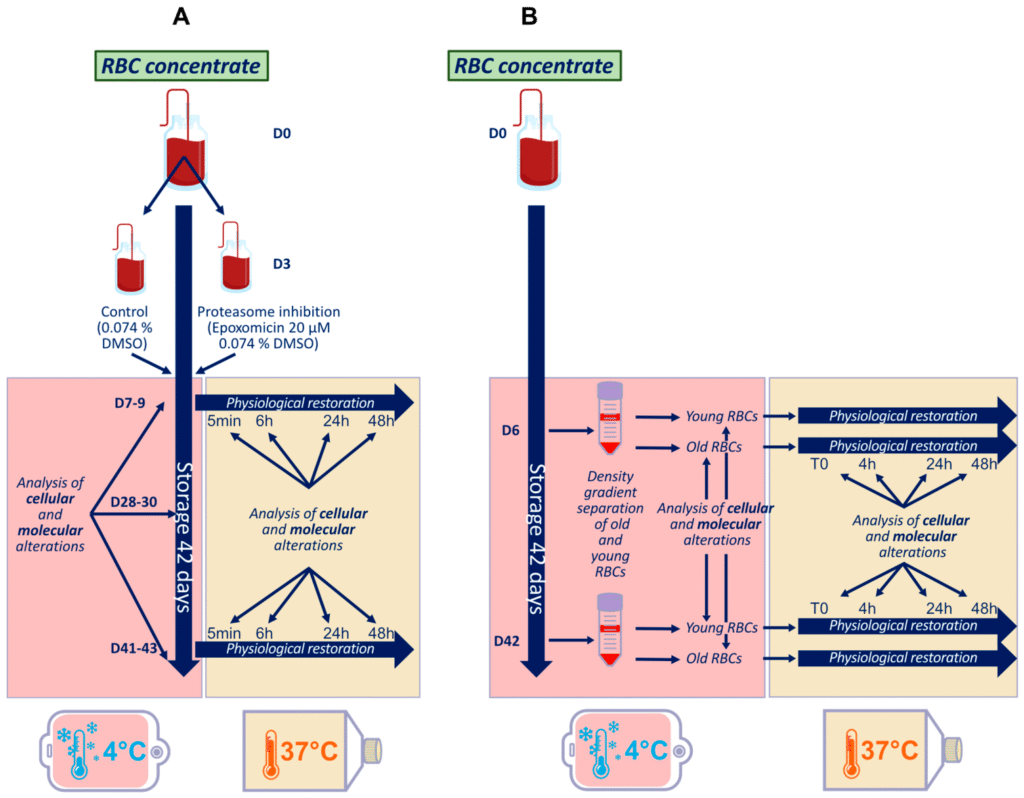
Pre-transfusion storage of red blood cells (RBCs) induces aging in vitro driven by metabolic and oxidative stress, limiting transfusion efficacy. Unlike nucleated cells where multiple hallmarks characterize aging, proteostasis is expected to play a main role in anucleate RBCs, including proteasomal protein degradation. Although proteasomal activity declines during aging in vitro, its role in generating downstream alterations and post-transfusion clearance remains unclear. We hypothesized that proteasome inhibition accelerates RBC aging in vitro, particularly following re-exposure to physiological conditions. We evaluated the impact of proteasome inhibition (i.e., epoxomicin) on RBC quality during storage and physiological restoration in vitro. Additionally, young and old RBC subpopulations were compared. Proteasome inhibition during storage depleted ATP and altered RBC morphology without immediate oxidative damage. Physiological restoration of proteasome-inhibited RBCs caused accelerated ATP depletion, massive protein aggregation, reduced deformability, hemolysis, and phosphatidylserine exposure, particularly in long-stored RBCs. Strikingly, RBCs aged in vivo also exhibited low proteasomal activity and behaved similarly to stored RBCs following physiological restoration. In conclusion, proteasomal dysfunction is a key hallmark of RBC aging and senescence, driving molecular and cellular modifications that mark RBCs for clearance in vivo. Therefore, enhancing proteasomal function could improve RBC storage quality and transfusion efficacy.
External link : https://www.mdpi.com/2076-3921/15/9/1146
The Proteasome Safeguards Red Blood Cell Integrity During Storage and After Transfusion
Antioxidants, 2026, vol.15, p.1146
Sandy Peltier, Théo Michel, Fanny Mialane, Mickaël Marin, Michaël Dussiot, Céline Rodriguez, Monika Dzieciatkowska, Marie Tamagne, Camille Roussel, Stéphanie Vicca, Olivier Hermine, Pierre A. Buffet, Benoit Vingert, Steven L. Spitalnik, Angelo D’Alessandro, Michel Prudent andPascal Amireault